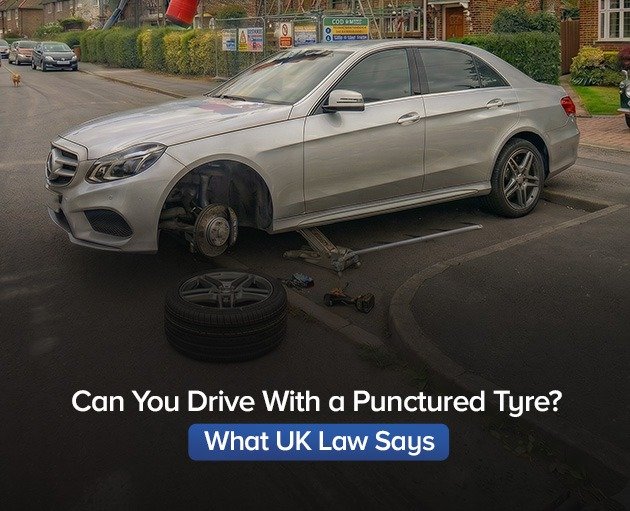
Can you drive with a punctured tyre in the UK? Legally, you cannot. Under the Highway Code, all four tyres must be correctly inflated and structurally sound at all times. A punctured tyre whether it’s fully flat or losing pressure renders your vehicle technically unroadworthy the moment the tyre can no longer maintain safe operating pressure.
The consequences of ignoring this are serious. The DVLA treats punctured, flat, or under-pressure tyres harshly: you could face a fine of up to £2,500, three penalty points on your licence, and potentially a driving ban if it is judged that you were driving in a dangerous condition. That is a significant price to pay for a 10-minute detour.
The Difference Between a Slow Puncture and a Blowout
Not all punctures announce themselves dramatically. London roads particularly around Hackney, Lewisham, and the heavily potholed stretches of the North Circular are notoriously hard on tyres. A nail picked up in a car park near Liverpool Street may sit quietly in your tread for days, slowly bleeding air.
It is possible to have driven on a Can you drive with a punctured tyre for weeks before noticing any issue. A nail in the tread would initially prevent air from escaping, but over time the tyre would begin losing pressure a classic slow puncture. Signs that something is wrong include noticeably altered steering response, your vehicle pulling to one side, and clunking or bouncing at low speed.
A blowout, on the other hand, is immediate and violent. Can you drive with a punctured tyre drops in an instant, and controlling the vehicle becomes extremely difficult. After a blowout, you should only exit the vehicle when you are certain it is safe to do so and you are out of harm’s way. Reflective warning cones or a triangle should be placed out before calling for recovery. Firststop
The key practical distinction for most London drivers is this: a slow puncture gives you a small window to act safely; a blowout gives you none.
What Happens to Your Car When You Keep Driving
Many drivers underestimate how quickly damage escalates once a tyre loses pressure. Driving on a flat tyre can result in internal tyre structural damage, wheel and vehicle damage, poor handling and control, and risk of accidents. It concentrates extra weight on the rim edges, which can bend, distort, or become permanently ruined. Your vehicle will pull severely to one side, making straight-line driving difficult.
If the Can you drive with a punctured tyre is still fully on the rim, it will provide some cushioning over a short distance but the rubber can begin to break off, exposing the metal of the wheel. This can cause more extensive and expensive damage to the wheel and suspension. Halfords
A puncture repair in London typically costs between £25 and £45. A replacement alloy wheel or suspension component? Comfortably ten to twenty times that. The maths are straightforward.
Run-Flat Tyres: The One Legitimate Exception
If your car is fitted with run-flat tyres common on many BMW, Mercedes, and Mini models the rules change slightly. Run-flat tyres are specially designed to maintain their shape and structure after a puncture, thanks to a reinforced supporting frame inside the tyre. This means you can continue driving safely for a short but potentially very useful distance to reach a place of safety. Manufacturers typically specify a maximum distance of around 50 miles at no more than 50mph after puncture check your vehicle handbook for the exact figures.
A critical point many drivers miss: once a run-flat Can you drive with a punctured tyre has been driven on after a puncture, even within those limits, it cannot simply be repaired and put back into service. It must be assessed and in most cases replaced by a qualified tyre technician.
If you are unsure whether your car has run-flat tyres fitted, look for the letters “RFT”, “SSR”, “ROF”, or “ZP” on the tyre sidewall, or check your manufacturer documentation.
Reinforced tyres (sometimes marked “XL” or “RF”) are a separate category entirely. Although reinforced tyres are strong and durable, designed for heavier or commercial vehicles, you should not continue driving on them with a puncture. This is a common misconception among van operators and fleet managers in London the “XL” marking means extra load capacity, not puncture tolerance.
What to Do the Moment You Suspect a Puncture
Whether you are on the South Circular, in a car park in Canary Wharf, or parked outside your house in Wimbledon, the steps are the same:
1. Do not panic
Keep a firm hold on the steering wheel. Reduce speed gradually by easing off the accelerator do not brake sharply.
2. Move to safety
Indicate and pull over to a safe area as soon as it is practical. On a motorway, aim for the hard shoulder or an emergency refuge area.
3. Switch on hazard lights
Make yourself visible to other road users, particularly in poor London visibility early morning drizzle on the M25 is no time to be invisible.
4. Assess the tyre before touching it
Check whether it is a slow leak or completely flat. The general advice is: do not drive at all if the tyre is visibly flat or rapidly losing pressure. Ansa
5. Call a professional
Changing a tyre on a live road is dangerous, particularly at night or in wet conditions. A mobile tyre fitting service can come to your location whether that’s a residential street in Islington, a business car park in Croydon, or a roadside in Barnet and carry out a safe, professional repair or replacement on the spot.
If you need an emergency puncture repair anywhere across London, Road Hero Tyre’s 24/7 emergency tyre service operates across all London boroughs. For non-emergency situations, you can also book a tyre puncture repair at a time that suits you.
Can the Puncture Be Repaired, or Does the Tyre Need Replacing?
This is one of the most common follow-up questions and the answer depends on where the damage is located and how far you have driven on it.
A Can you drive with a punctured tyre can be repaired if the damage is within the central three-quarters of the tyre, has not been previously repaired in the same area, the tread depth remains above the legal minimum of 1.6mm, and there is no further damage to the rubber or internal structure. Prestige Wheels
Sidewall punctures, tears, or damage from kerb strikes (all very common in dense London traffic) cannot legally be repaired and require a full replacement.
| Puncture Type | Repairable? | Notes |
|---|---|---|
| Small nail/screw in central tread | Usually yes | Must be within central ¾ of tread |
| Sidewall puncture | No | Always requires replacement |
| Blowout damage | No | Internal structure compromised |
| Previously patched area | No | British Standard BS AU 159 prohibits this |
| Damage with <1.6mm tread | No | Below UK legal minimum |
Our straight tyre repair service follows British Standard BS AU 159 the recognised UK benchmark for puncture repairs. We will always tell you honestly whether a repair is appropriate, or whether a tyre replacement is the safer option.
A Word on Tyre Pressure and Regular Checks
One of the most effective ways to catch a slow puncture before it becomes a roadside emergency is a simple monthly tyre pressure check. The recommended tyre pressure for your vehicle is printed inside the driver’s door sill or in the owner’s manual not on the tyre sidewall, which shows the maximum pressure.
Tyre pressure should be checked cold (before driving more than 2 miles). London’s stop-start traffic and frequent kerb parking mean tyres take more punishment here than on rural roads. A tyre that looked fine in a Peckham car park on Monday can be significantly underinflated by Friday.
For a deeper look at how tread depth affects safety and what to check during a routine inspection, read our guide to tyre tread depth and when to replace your tyres.
FAQs
Can I use tyre foam or an inflation kit to get home instead of calling a tyre fitter?
Tyre sealant foam and inflation kits — often supplied in newer cars instead of a spare wheel — can get you moving again after a minor tread puncture, but with strict limitations. They are a temporary measure only, typically designed for small nail or screw punctures in the central tread area. They will not seal a sidewall puncture, a tear, or any damage larger than around 4mm. Once foam has been used, the tyre must be assessed and professionally repaired or replaced as soon as possible — most manufacturers recommend within 100 miles. Importantly, foam-treated tyres cannot always be repaired afterwards; the sealant can damage the inner liner, which may mean a full replacement is required. If your car's manual includes a tyre inflation kit, read the instructions before you are ever stranded — not on the hard shoulder in the dark.
Does a puncture affect my MOT?
Not directly in the sense that a puncture will not cause an MOT failure on its own — because you should never drive to an MOT test centre on a punctured tyre. However, tyre condition is one of the most scrutinised elements of an MOT inspection. If a tyre shows signs of previous puncture damage that was not repaired to British Standard BS AU 159 — for example, a plug-only repair, a repair in the sidewall, or a patch over an area already repaired before — it will result in an MOT failure. Similarly, if driving on a puncture has caused internal structural damage that is not visible from the outside, a competent MOT tester may still identify it during the tyre flex and inspection checks. Always have a puncture professionally assessed before presenting the vehicle for its MOT.
How do I know if I have a slow puncture rather than just low tyre pressure?
The symptoms overlap, which is why slow punctures often go undetected for days or even weeks. The key difference is pattern and rate of change. Normal seasonal pressure loss is gradual — roughly 1 PSI per month, accelerated slightly in cold weather. A slow puncture loses pressure faster and inconsistently: you might top the tyre up one week and find it noticeably soft again within a few days. Other indicators specific to a slow puncture rather than general pressure loss include the car pulling to one side even after you have corrected the pressure, a visible nail or screw in the tread (which may actually be sealing the hole temporarily), and one tyre consistently reading lower than the other three on your TPMS. If you are in any doubt, have the tyre inspected off the vehicle — a tyre technician can submerge it in water to locate even the smallest air leak in under a minute.
Can a pothole cause a puncture, and is anyone liable for the damage in London?
Yes — pothole impacts are one of the most common causes of both punctures and sidewall damage on London roads, particularly on heavily trafficked routes through areas like Lewisham, Haringey, and parts of outer east London. The sudden compression of the tyre against the rim can pinch the inner liner, causing what is known as an impact fracture or pinch puncture — damage that is often internal and invisible from the outside but structurally serious. As for liability: you can make a pothole damage claim against the relevant local authority or Transport for London if the pothole was of a reportable size and had not been repaired within a reasonable timeframe after being reported. You will need photographic evidence of the pothole, your repair receipts, and ideally confirmation that the defect was already logged. Claims are not guaranteed — councils often defend on the basis of reasonable inspection schedules — but they are worth pursuing for significant tyre or wheel damage. Report London potholes directly via the TfL or relevant borough council website to create a formal record.
The Bottom Line
Can you drive with a punctured tyre? In almost every real-world scenario: no. It is unsafe, potentially illegal, and far more expensive in the long run than calling for help immediately.
The one partial exception is a genuine run-flat tyre, used within its stated limits but even then, the goal is to reach a safe location for professional assessment, not to carry on with your journey.
London roads are unforgiving. Between the potholes on the A406, the kerb-heavy parking in Brixton, and the sheer volume of debris on construction routes through Elephant & Castle and Nine Elms, tyre damage is more a question of when than if. The drivers who handle it best are the ones who know what to do before it happens.
If you’ve got a puncture right now, our RH Mobile Tyre team can come to you, wherever you are in London.
For UK tyre safety guidance and the latest standards, visit Can you drive with a punctured tyre the UK’s leading tyre safety charity.