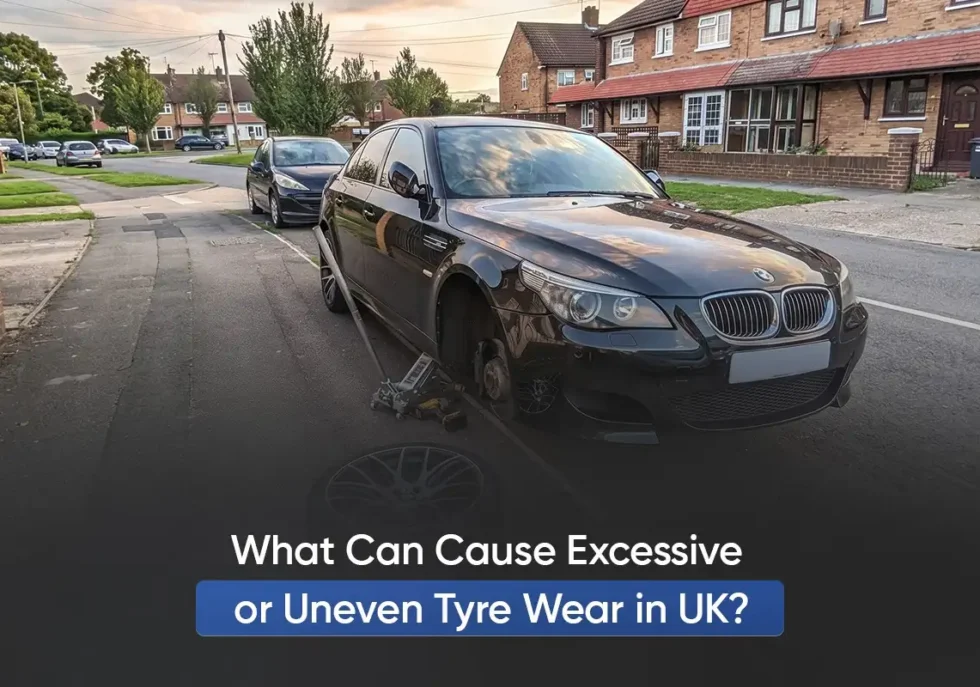
You pull up to the kerb on a Tuesday morning in Clapham, and something looks off. One tyre’s worn smooth on the outside edge. The others look fine. You’ve done nothing different same school run, same route down the South Circular, same Tesco car park. So why is one tyre chewing through rubber while the rest sit pretty?
What can cause excessive or uneven tyre wear is one of those questions that sounds simple but pulls at a surprisingly long thread. Pressure, alignment, suspension, driving habits usually it’s a combination, and usually it’s been building for longer than you’d think.
Here’s what’s actually going on.
Why Uneven Wear Matters More Than You Think
A new tyre starts life with around 8mm of tread. The legal minimum in the UK is 1.6mm across the central three-quarters of the tyre. Most tyre safety professionals and TyreSafe recommend replacing at 3mm, because below that, wet braking distances start to stretch noticeably. On a wet October morning on the A10, that gap matters.
What can cause excessive or uneven tyre wear can take a tyre from “looks fine from a distance” to below the legal limit on one edge without the rest of the tread giving you any warning. That’s exactly the pattern that catches drivers out at MOT time.
If you’re not sure what legal tread depth looks like in practice, our guide to tyre tread depth and when to replace walks through it clearly.
The Main Causes of Excessive or Uneven Tyre Wear
1. Wrong Tyre Pressure
This is the big one. Incorrect tyre pressure is the single most common cause of what can cause excessive or uneven tyre wear, and it splits neatly into two patterns:
- Underinflation makes the tyre bow outward under load, putting more contact on both outer edges. You’ll see faster wear on the shoulders of the tread while the centre stays relatively intact.
- Overinflation does the opposite. The tyre bulges in the middle, so the centre strip takes all the punishment while the edges barely touch the road.
London driving makes this worse. Short city trips Brixton to Elephant, Hackney to Canary Wharf mean the engine rarely gets fully warm, and tyre pressure gauges at petrol stations get ignored. If you haven’t checked yours in the last month, check it today.
Your correct pressures are in the driver’s door jamb or the owner’s manual. They’re not the number printed on the tyre sidewall that’s the maximum, not the target.
2. Wheel Misalignment
Wheel alignment refers to the angles at which your tyres sit relative to each other and the road. When those angles drift usually after a pothole, a clipped kerb, or any significant impact the tyres no longer roll straight. They scrub sideways slightly with every rotation.
The result is one-sided wear: one edge of a tyre grinds down while the other stays relatively untouched. It can happen slowly enough that you don’t notice until the MOT, or fast enough that a tyre goes from fine to illegal in a few thousand miles.
London roads don’t help. The capital’s potholes are a genuine problem TfL receives thousands of pothole reports every year, and streets like parts of the A406 North Circular or back roads in Lewisham and Haringey can knock alignment out in a single hit.
Getting your alignment checked is quick and cheap. It’s worth doing after any significant pothole strike, and as a matter of routine every 12 months or 10,000 miles. Our mobile tyre fitting service team can advise whether we spot any obvious wear patterns when we visit.
3. Worn or Damaged Suspension Components
Shock absorbers, ball joints, control arm bushings these parts keep your tyres in consistent contact with the road. What can cause excessive or uneven tyre wear out, the tyre starts to bounce and skip rather than roll smoothly. That inconsistent contact shows up as patchy or cupped wear: sections of tread worn down in a repeating scalloped pattern.
A fleet manager based in Park Royal once described it as “tyres that looked fine until you put them on a flat surface and saw they’d gone lumpy.” Cupped wear is hard to spot without getting down and looking properly, but once you know what you’re looking for, it’s obvious.
Suspension wear is also a known MOT failure point. If your car is older or you do high mileage cab drivers in London often cover 40,000+ miles a year suspension components deserve regular attention, not just a quick look at the tyres.
4. Driving Style and Habits
Hard cornering, aggressive acceleration, and heavy braking all put irregular stress on tyres. The fronts take a pounding from steering and braking; the rears carry load. Failing to rotate your tyres swapping front for rear means each axle keeps the same job indefinitely, and wear becomes predictably uneven.
Stop-start London driving is a specific problem here. The constant braking and pulling away in traffic around Tottenham Court Road or the Blackwall Tunnel approach What can cause excessive or uneven tyre wear front tyres faster than almost anything else. On vehicles where the manufacturer recommends rotation (check your handbook), doing it every 6,000 to 8,000 miles keeps wear even across all four.
Tyre rotation is a straightforward job our mobile tyre repair team can carry out at your location.
5. Braking System Faults
A sticking brake calliper can drag against the disc continuously, generating heat and wearing the corresponding tyre far faster than the others. If one tyre is consistently hotter than the rest after a drive, or if you notice the car pulling slightly to one side under braking, the brakes are worth inspecting before assuming it’s a tyre problem.
This is one cause of what can cause excessive or uneven tyre wear that drivers often miss because the symptom looks like a tyre issue but the fix is in the brakes.
Tyre Wear Patterns at a Glance
| Wear Pattern | Where You See It | Likely Cause |
|---|---|---|
| Centre wear | Middle strip only | Overinflation |
| Edge wear (both sides) | Both outer edges | Underinflation |
| One-sided wear | One edge only | Misalignment or camber issue |
| Cupped / scalloped | Patchy around the circumference | Worn suspension |
| Feathering | Diagonal ribs worn at an angle | Toe misalignment |
| Flat spots | One or more flat patches | Harsh braking, locked wheels |
What the Law Says
The UK legal minimum tread depth is 1.6mm across the central three-quarters of the tyre, around its full circumference. Getting caught with a tyre below that limit means a £2,500 fine per tyre and three penalty points. For a van with four worn tyres, that’s a £10,000 exposure and a potential driving ban.
Uneven wear can mean one part of the tyre is legal while another isn’t. That’s not a grey area if any part of the central three-quarters falls below 1.6mm, the tyre is illegal.
The 20p test gives a quick check: push a 20p coin into the main tread groove. If you can see the outer rim of the coin, the tread is too low. If the rim disappears inside the groove, you’ve got more than 3mm and you’re well within legal limits.
Prevention: What Actually Helps
- Check tyre pressure monthly and before any long drive. A decent digital gauge costs about £10 and lives in the glovebox.
- Rotate tyres every 6,000 to 8,000 miles if your vehicle supports it.
- Check alignment after any pothole strike or kerb impact, and annually otherwise.
- Inspect your tyres properly not just a glance, but a walk-round with a look at each sidewall and tread edge.
- Address suspension or brake issues early. Letting a worn ball joint run is expensive both in replacement parts and the tyres it destroys.
If you’re not certain what you’re looking at, our mobile puncture repair team is happy to give an honest tyre assessment when we come out no obligation to book a replacement if it’s not needed.
FAQs
Does uneven tyre wear affect my car insurance?
It can. If you're involved in an accident and your tyres are found to be below the legal 1.6mm tread depth or show signs of neglect that contributed to loss of control your insurer can reduce or refuse your claim. UK insurers expect drivers to maintain their vehicles in a roadworthy condition; tyres fall squarely within that. Uneven wear that's been left unchecked to the point of illegality is treated the same as bald tyres. It's also worth knowing that driving on an illegal tyre carries a £2,500 fine and three penalty points per tyre, so the insurance issue is secondary to the legal one.
Do electric vehicles wear tyres faster than petrol or diesel cars?
Yes noticeably so. EVs are heavier than equivalent petrol cars because of the battery pack, and they deliver torque instantly rather than building it gradually. That combination puts more stress on the contact patch every time you pull away. Tyre manufacturers including Michelin and Bridgestone now produce EV-specific tyres with reinforced sidewalls and harder compounds to handle the load. If you drive an EV in London particularly a heavier SUV-style model like a Tesla Model Y or Kia EV6 and you're fitting standard passenger tyres, you'll likely find they wear faster than expected. Check whether your vehicle has a specific tyre recommendation in the owner's manual.
What is tyre feathering, and is it different from one-sided wear?
They're related but not the same thing. One-sided wear means one edge of the tyre is significantly more worn than the other usually caused by a camber or alignment problem. Feathering is subtler: the tread blocks wear at an angle, so each block feels sharp on one side and rounded on the other, a bit like the pages of a worn paperback. Run your hand across the tread if it feels smooth one way and catches the other, that's feathering. It points specifically to toe misalignment, where the wheels point slightly inward or outward rather than straight ahead. Both issues need an alignment check, but feathering can be easy to miss on a visual inspection because the tyre doesn't look obviously worn from a distance.
Can London's speed bumps and potholes genuinely cause uneven tyre wear?
Yes, and it's more common than most drivers realise. A single sharp pothole impact can knock wheel alignment out enough to start producing uneven wear within a few thousand miles. Speed bumps are a slower problem hitting them at speed repeatedly stresses the suspension components that keep your wheels pointing true, particularly ball joints and control arm bushings. Areas with heavy traffic calming like parts of Hackney, Southwark, and Waltham Forest have noticeably rough road surfaces. If you've recently driven through a bad pothole the kind that jolted the whole car it's worth having your alignment checked rather than waiting to see whether a wear pattern develops.
When to Get a Professional Opinion
What Can Cause Excessive or Uneven Tyre Wear? If you’ve spotted uneven wear and you’re not sure what’s caused it, don’t just replace the tyre and move on. A new tyre on a misaligned axle will wear out just as fast as the one you just removed.
Before fitting replacements, it’s worth understanding What can cause excessive or uneven tyre wear happened. If it’s pressure-related, that’s an easy fix. If it’s alignment or suspension, those need addressing first otherwise you’re just buying time.
You can read more about what happens if you leave a damaged tyre in use in our guide on driving with a punctured tyre.
For a reliable external reference, TyreSafe the UK’s leading tyre safety charity publishes clear guidance on checking and maintaining tyres at tyresafe.org.
Got a tyre that’s wearing unevenly and you’re not sure why? Book a free tyre inspection with RH Mobile Tyre we come to your home, workplace, or wherever the car is in London. No garage trip, no waiting room, no upsell.