You’re halfway to work, traffic’s moving well for once, and then you spot it. That little amber horseshoe with an exclamation mark glowing on your dashboard. The tyre pressure light (also called the tire pressure light, tyre warning light, or simply the tire light) is on.
First thing: don’t panic. In most cases, this isn’t an emergency, but it is something you should sort out the same day. This guide explains exactly what the tyre pressure light means, why it comes on, and the precise steps to take whether you’re parked up in Canary Wharf, stuck in Brixton traffic, or just leaving home in East London.
What Is the Tyre Pressure Light?
The tyre pressure light, also known as the tyre pressure warning light, is part of your car’s Tyre Pressure Monitoring System (TPMS). This dashboard warning alerts you whenever tyre pressure falls below the manufacturer’s recommended level, or TPMS. Every new passenger car sold in the UK since November 2014 has been fitted with one by law. The system continuously monitors the air pressure inside each tyre and triggers a dashboard warning the moment one or more tyres drop significantly below the recommended level.
The tyre pressure symbol, sometimes referred to as the tyre pressure sign, looks like a cross-section of a tyre with an exclamation mark in the centre. It glows amber rather than red, indicating a warning rather than an immediate emergency.
One important thing to understand: the tyre pressure light doesn’t always mean you have a puncture. There are several reasons it comes on, and knowing which one you’re dealing with changes what you do next.
Why Has Your Tyre Pressure Light Come On? 7 Real Causes
1. Your tyres have slowly lost air over time
Tyres naturally lose about 1-3 PSI per month due to normal use. If you haven’t checked your pressures in a few months, this is likely the culprit. A quick top-up at a petrol station usually fixes it.
2. Cold weather (very common in London winters)
For every 10°F (roughly 5.5°C) drop in temperature, a tyre loses about 1 PSI. In London, where temperatures can swing 10 to 15 degrees between an autumn morning and afternoon, your TPMS sensor can trigger without anything being wrong with the tyre itself. If your tyre pressure light or low air pressure light came on overnight after a cold snap, cold temperatures are the most likely reason.
3. A slow puncture
A slow puncture is trickier because you might not notice it at first. The tyre holds enough air to look fine visually, but pressure is dropping steadily. If your light came on and came back again within days of reinflating, a slow puncture is the likely cause. You’ll want to get this checked. Driving on an underinflated tyre stresses the sidewall and can lead to a blowout.
Understanding whether you have a slow puncture or simple pressure loss matters. See our detailed guide on Can you drive with a punctured tyre for a clearer picture.
4. A sudden puncture or tyre damage
If the light comes on while you’re driving and your steering starts pulling to one side, or you can feel something is wrong with how the car handles, stop safely as soon as you can. This is different from a slow pressure drop . It’s more urgent.
5. A faulty TPMS sensor
The sensors inside your wheels run on small batteries. They typically last 5 to 10 years, but once the battery goes, the sensor can start giving inaccurate readings or trigger the warning light for no real reason. If your tyre pressures are all correct but the tyre pressure light keeps coming on, a faulty sensor is often the cause.
Worth knowing: a faulty TPMS light displayed at MOT time can result in an automatic failure. That’s been the case since January 2015 for cars manufactured from 2012 onwards.
6. Recent tyre change or rotation
If the tyre pressure light came on after a recent tyre change or seasonal swap, the TPMS sensors may simply need to be re-synced or reset. This is a common oversight after tyre replacements and is easy to sort out.
7. Overinflation
Less common, but worth mentioning. If you’ve recently inflated your tyres and gone past the recommended pressure, some TPMS systems will flag it. Overinflated tyres wear unevenly and reduce road grip, so getting the pressure right in both directions matters.
Steady Light vs. Flashing Light: What’s the Difference?
This is one of the questions we hear most often, and it’s a useful distinction to know.
| Light behaviour | What it usually means |
|---|---|
| Steady amber light | One or more tyres are underinflated. Check pressures and top up. |
| Flashing on start-up, then stays on | TPMS sensor fault. Pressures may be fine, but the system isn’t working correctly. |
| Flashing intermittently while driving | Often caused by cold temperatures affecting air pressure momentarily. Still worth checking. |
| Red light (on some vehicles) | Severe pressure loss. Stop safely as soon as possible. |
A steady tyre pressure light is the most common scenario. It tells you to check your pressures it doesn’t necessarily mean you have a problem beyond low air.
Step-by-Step: What to Do When Your Tyre Pressure Light Comes On
Step 1: Don’t brake sharply or make sudden steering changes
If you’re driving when the light comes on, keep calm. Avoid any sudden manoeuvres. This reduces the risk if you do have a puncture.
Step 2: Find a safe place to pull over
Have a quick look at all four tyres from a distance. If one looks visibly flat or the car is sitting unevenly, you likely have a puncture. If they all look fine, it’s probably a pressure drop.
Step 3: Check your tyre pressures
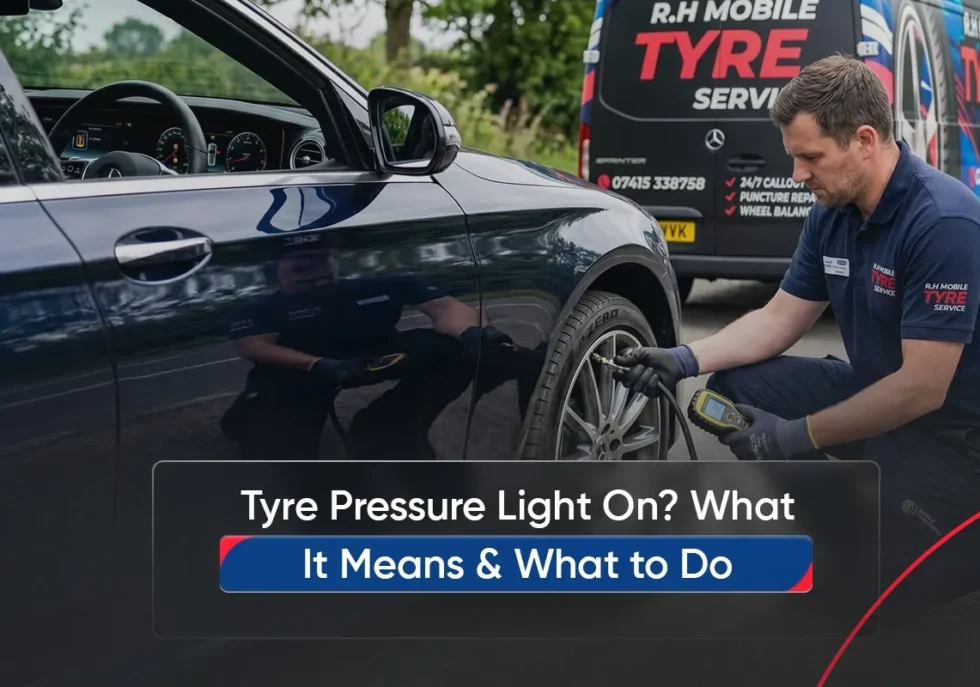
The recommended pressure for your car is printed on a sticker inside the driver’s door jamb (or sometimes the fuel cap). It’s listed in PSI or Bar. Most petrol stations have an air machine; use it to check and inflate each tyre to the correct pressure. You can also use a handheld pressure gauge if you’re unsure why the low tire pressure light has appeared.
Don’t guess. Even 5 PSI low across all four tyres affects fuel economy, handling, and tyre life. You can also read up on when your tyre tread depth means it’s time for a new tyre to make the most of your check while you’re at it.
Step 4: Reset the TPMS
On most modern cars, the tyre pressure warning light won’t switch off automatically after inflating your tyres. Once the correct pressure is restored, reset the TPMS according to your vehicle’s instructions. You need to reset it. The method varies by manufacturer, but it’s usually found in the vehicle settings menu or via a dedicated “TPMS reset” button under the steering wheel. Check your owner’s manual if you’re not sure.
Step 5: Drive briefly and monitor
After resetting, drive at over 25 mph for a few minutes. The sensors need motion to register the updated pressure. If the light goes out and stays out, you’re fine.
Step 6: If the light comes back on
If the tyre pressure light returns within a day or two, even after you’ve checked and corrected the pressures, you’re likely dealing with either a slow puncture or a faulty sensor. At that point, it’s worth getting a professional look. Our mobile puncture repair service covers most of London and can come to you, so you don’t have to drive on a suspect tyre.
How to Prevent the Tyre Pressure Light from Coming On
The easiest way to avoid seeing the tyre pressure light or low tire pressure light is to check your tyre pressures at least once a month and before every long journey.
A few things that help:
- Check cold, not hot. Tyre pressure rises as the tyres heat up from driving. Always check pressures when the car has been parked for at least two hours.
- Check all four, not just the one you think is low. The TPMS tells you something is wrong, but on older systems, it doesn’t always pinpoint which tyre.
- Change to winter or all-season tyres before October. Summer tyres lose more pressure in cold weather, and a sudden cold spell in London can trigger your tyre pressure light within days.
If you’d like a full mobile tyre fitting or a tyre health check ahead of winter, our team covers London and surrounding areas. We come to your home, workplace, or wherever your car is parked.
FAQs
Will the tyre pressure light fail my MOT?
For vehicles registered from 2012 onwards, a TPMS warning light caused by a system fault (a dead sensor battery, a damaged sensor, a system malfunction) is a straight MOT failure. This has been the case since January 2015.
If the light is on simply because a tyre is underinflated, inflating it to the correct pressure should clear the light before the test. Once the light is off and the TPMS is working normally, the car can pass. Vehicles registered before 2012 are not subject to TPMS requirements in the MOT. If your MOT is coming up and the light is on, get it checked beforehand rather than hoping it clears itself.
Why does my tyre pressure light keep coming back on after I've already topped up the tyres?
There are three likely causes. The most common is a slow puncture: the tyre is losing air gradually through a nail, screw, or tiny sidewall crack. It holds enough pressure to look fine, but drops again within a day or two. The second is a faulty TPMS sensor whose battery has died or whose signal is unreliable. The third, and easily overlooked, is that the system was never properly reset after you inflated the tyres. Some cars won't clear the light automatically they need a manual reset or a short drive above 25 mph to re-register the new pressure.
If you've inflated, reset, and driven the car and the tyre pressure light still returns within 48 hours, a slow puncture is the most likely explanation. A mobile tyre technician can check all four tyres on the spot and confirm whether you need a repair or a replacement.
Does the tyre pressure light show which specific tyre is flat?
Newer vehicles with direct TPMS, which use a physical sensor inside each wheel, can display which tyre is affected on the dashboard or infotainment screen. Many modern Fords, BMWs, Volkswagens, and most cars made from around 2018 onwards have this capability.
Older indirect TPMS systems work by comparing wheel rotation speeds via the ABS sensors rather than measuring pressure directly. These systems know that pressure has dropped somewhere, but can't pinpoint which tyre. If your car just shows the generic warning light without specifying a wheel, check all four manually. Front tyres tend to lose pressure faster due to the weight distribution and steering input they carry.
Can cold weather alone trigger the tyre pressure light, even if there's nothing wrong with the tyres?
For every 10°F (around 5.5°C) drop in temperature, a tyre loses approximately 1 PSI of pressure. On a cold November morning in London, where overnight temperatures can drop from 12°C to 3°C or below, your tyres can shed 2 to 3 PSI without a single nail involved. If they were already sitting near the lower end of the recommended range, that small drop is enough to trigger the warning.
The fix is straightforward: top up to the correct pressure when the tyres are cold (before you've driven more than a couple of miles), then reset the TPMS. The light should clear and stay off unless the temperature drops significantly again. If it keeps coming back through the winter even after topping up, check that your pressures are set at the higher end of the recommended range rather than the minimum.
When to Call a Professional
Most tyre pressure light situations are straightforward. But call a tyre specialist if:
- The light came on while driving, and the car is handling oddly
- One tyre looks visibly flat or deflated
- The light keeps returning after you’ve topped up the pressures
- Your TPMS light is on, and you have an MOT coming up
- You’re not comfortable checking or adjusting pressures yourself
For London drivers, our 24/7 emergency tyre service means you’re never stuck. Whether you’re outside Liverpool Street at 7 am or in a residential street in Clapham late at night, we can get to you.
For broader advice on tyre safety and road-legal requirements, the RAC’s tyre safety guide is a reliable UK reference worth bookmarking.